

Blogs
Home
📋 Table of Contents
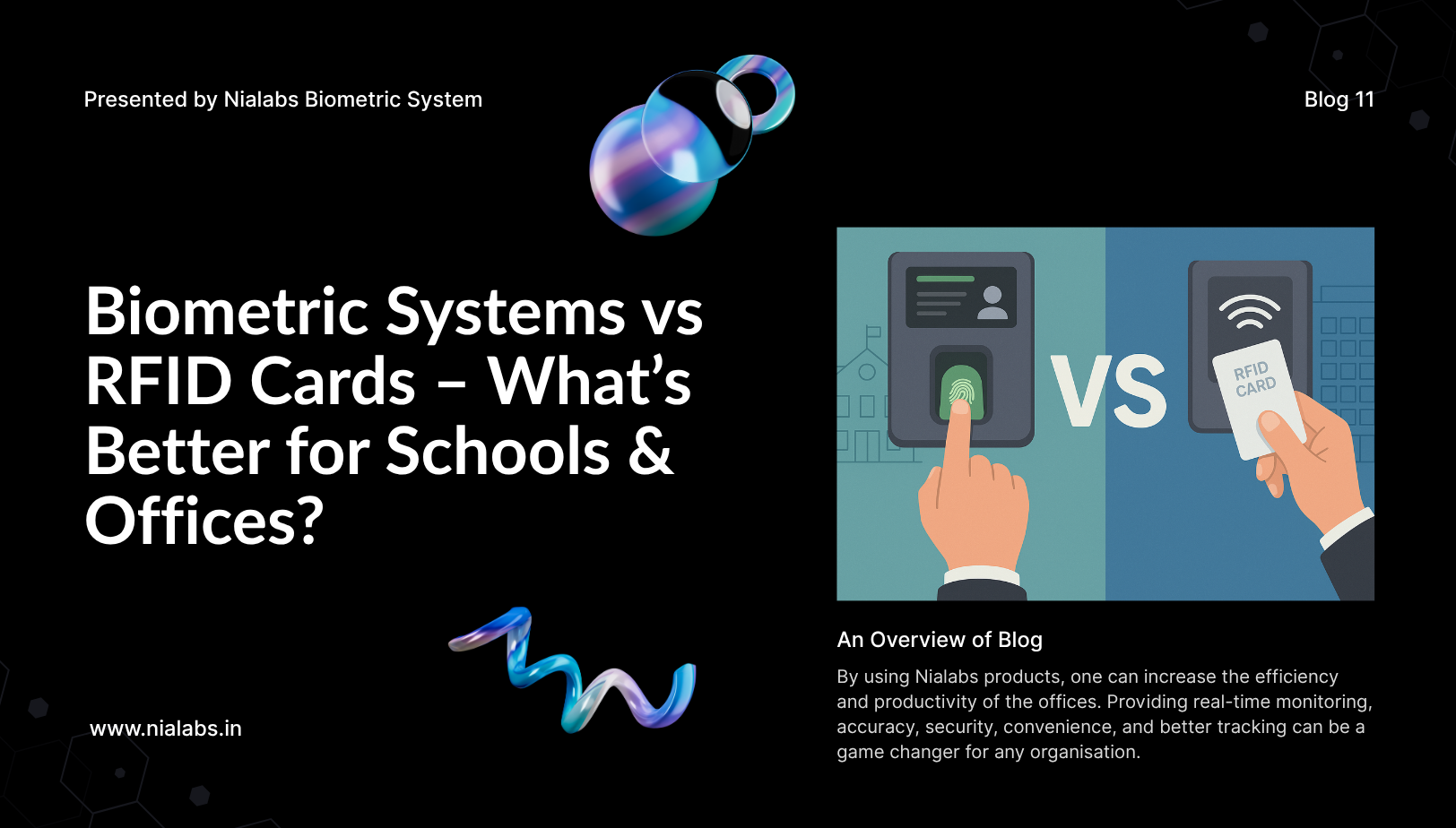
Biometric Systems vs RFID Cards- What’s Better for Schools & Offices?
12 Nov, 2025
Contemporary education and employment institutions do not rely on registers or swipe cards to generate attendance. Institutions are resorting to smart technologies as demand for efficiency, safety, and real-time information increases. Some of the most used systems include the biometric attendance system and RFID card-based systems.
Both systems are intended to report attendance and manage access, but they differ in their operation, security, and convenience. These variations may help you choose the best system suitable for application in schools or offices.
What are RFID card systems?
RFID stands for ”radio frequency identification.” It operates on smart cards, which contain small chips and antennas within them. By tapping or swiping the card against a reader, an individual sends wireless information to take attendance or gain entry.
The success of the RFID card attendance system is largely due to its cost-effectiveness and ease of installation and use. Most schools and offices often start with the RFID systems as their initial move towards automation.
Nevertheless, the greatest negative aspect of RFID systems is that they can be easily abused, as cards may be lost, shared, or even duplicated. Some examples are a student handing over his/her card to a friend to represent attendance or an employee punching in on behalf of a colleague. These loopholes may result in inaccuracy of data and security risks—something that most modern institutions can no longer afford.
What Are Biometric Systems?
Biometric systems, on the other hand, are systems that are based on individual physical or behavioural features like fingerprints, facial patterns, or iris patterns to recognize an individual. There are no two people with a similar biometric feature, and thus, it is the most accurate and safe way to go.
Unlike RFID cards, biometric systems do not require one to carry anything. It is a seamless process, as attendance is verified in real time by a fingerprint scan or a facial recognition system without any doubt.
Most of the biometric systems today work based on artificial intelligence and thus can extend beyond merely tracking attendance. They can run reports, monitor attendance patterns, integrate with payroll or ERP systems, and deliver actionable insights that enable organizations to work smarter.
Major difference between Biometric and RFID:
Even if they are both attendance management systems, the biometric and RFID systems are two entirely different systems when it comes to the way they work, their reliability, and how and where they can be used.
1. Biometric Systems:
-
A biometric system is one of a kind as far as accuracy and true features are concerned. They are verifying people based on who they are instead of what they have. It addresses issues such as proxy attendance, card data loss, or data tampering. Each entry is one of a kind and is logged securely, so you get complete transparency.
-
In terms of security, biometrics offer better protection, as the encrypted personal information is not easily duplicated or shared.
-
Biometric systems also have an advantage in terms of convenience: you don’t have to carry or keep track of a card, which means less hassle for users and administrators.
2. RFID Systems:
-
RFID-based schemes, however, are based on physical cards associated with a person’s identity. They can be less secure as well, but are simpler and quicker to use. Cards can be lost, copied, or given away to another person, causing fraud and errors.
-
RFID cards are also more susceptible to theft and unauthorized use.
-
RFID remains a good choice for those organizations that regard speed and cost-effectiveness as more important than the highest levels of security.
Why Schools Are Choosing Biometric Systems
Biometric systems for schools deliver accuracy, security, and confidence. They eliminate the risk of proxy attendance and allow administrators to maintain accurate digital records. Most systems can also send parents real-time notifications when their students depart or arrive, fostering transparency and communication.
Biometric technology is making workforce management easier as timesheets and reports are generated automatically. Cutting down on paperwork and manual tracking enables schools to conserve valuable administrative resources and still uphold accountability.
Why Offices Need Biometrics Systems
Biometric systems for offices are used to support discipline and the integrity of information. They remove buddy punching, provide real-time attendance, and limit entry to secure locations.
Touchless facial recognition technology has been particularly useful in the current environment, focused on hygiene, providing security, and efficiencies. For HR teams, automated attendance data and payroll integration make them even more efficient.
When RFID Works Best
RFID can also be useful in low-security or high-traffic locations where speed and convenience are the key factors. They can be applied in short-term events like a conference or visitor management, or as a step towards biometrics in an organization that intends to introduce it in the future.
Despite being less secure, RFID is a cost-saving alternative for those institutions in need of a basic attendance solution that does not require the use of large-scale infrastructure.
Nialabs - Building the Future of Smart Attendance
At Nialabs, we create AI-powered biometric systems that are designed to be used in contemporary schools and offices. Our superior solutions are not limited to a simple tracking system—they include real-time monitoring, cloud-based integration, automated reports, and efficient ERP integration.
No matter what your ambitions are, be it to improve the safety of students or to make workforce management smoother, Nialabs can assist you in building a safe, smart, future-driven, and secure attendance system.
Conclusion:
The world is becoming automated with data-driven decision-making, and real-time attendance tracking cannot be an exception. Although RFID systems were significant in the past, biometric technology is the way ahead, and it is secure, contactless, and intelligent.
Schools and offices can use smart attendance solutions by Nialabs to make attendance not only a routine task but also an element of smarter, safer, and more connected operations.
✍️ Muskan Singh
Hi, I'm Muskan Singh, a content writer passionate about exploring how technology, EdTech, and SaaS are shaping the...
Show More📞 Get In Touch
We'd Love to Hear From You!
✍️ Muskan Singh
Hi, I'm Muskan Singh, a content writer passionate about exploring how technology, EdTech, and SaaS are shaping the...
Show More📞 Get In Touch
We'd Love to Hear From You!
Related Blogs