

Blogs
Home
📋 Table of Contents
Understanding the Role of Biometric Face Attendance Machines in Modern Workplaces
05 Oct, 2024
In today’s technologically driven world, one does not want to stay behind their competitors. There are so many things that can help you in making your organization outperform in the marketplace. One such thing is Biometric Technologies.
Biometric technologies help improve the security of an organization and streamline employee management. Among these technologies, biometric face attendance machines are a powerful tool for modern workplaces.
NIALABS enables you to modernize your firm by moving from traditional methods to advanced ones so you can perform better in the long run. Every business wants to thrive in its respective industry, and using biometric technology can help achieve that dream goal. In this blog, we will try to understand the role of biometric face attendance machines in modern workplaces and have a detailed look into their various aspects with FAQ’s.
BIOMETRIC TECHNOLOGIES
Biometric technologies use special features of an individual to verify their identity. Human traits are unique for each individual and are ideal for security purposes, identification, and efficient management. These technologies are designed to recognize distinct human attributes such as fingerprints, facial features, voice patterns, or even iris structures.
Types of Biometric Technologies:
Fingerprints Recognition:
This is the most used biometric system, where the impressions of ridges on an individual’s fingertips are captured. It is a contact-based biometric system where you must place your finger on the scanner machine. It is widely used across the globe, and it's one of the earliest systems of attendance. It is commonly used in smartphones, security systems, and time attendance systems.
Face Recognition:
Facial recognition biometric systems use different features of an individual’s face to record attendance. These features include distance between the eyes, nose width, and jawline features to verify an individual’s identity and mark their attendance. Face recognition systems are highly used in schools, colleges, workplaces, and on smartphones for user access.
Iris Recognition:
Iris recognition scans the unique patterns in a person’s iris, the colored part of the eye. Since iris patterns are highly unique, this technology is considered one of the most accurate biometric methods and is often used in high-security applications.
Voice Recognition:
This biometric system enables access to an individual by recognizing their voice. It analyzes the vocal features, such as pitch, sound, tone, and texture, of an individual’s voice. This system is mainly used for customer services or personal assistance technologies like smart speakers.
Retina Scanning:
Retina scanning is a biological biometric type of system where the blood vessels of the retina at the back of the eye are scanned. This type of biometric system is a little complex and not widely used. It also compels huge investment.
Palm Vein Recognition:
This system uses infrared light to capture the unique pattern of veins in a person’s palm. Palm vein recognition is highly secure because the vein pattern is internal and cannot easily be altered or forged.
What is a Biometric Face Attendance Machine?
A biometric face attendance machine is a system that uses facial recognition technology to track and record employee attendance. Face recognition biometric systems use different features of an individual’s face. These features include distance between the eyes, nose width, and jawline features to verify an individual’s identity and mark their attendance. Every time the employee reports to work, the machine matches the captured real-time image with the stored biometric data to verify their identity and log their attendance.
Benefits of Biometric Face Attendance Systems:
Accuracy and Precision:
Face biometric attendance machines provide more accuracy than traditional methods of attendance. As they use an individual’s facial features to record their attendance, it overcomes the drawbacks of earlier attendance methods. Conventional methods like punching cards can be manipulated, and PIN-based methods are proxies for faking attendance. It eliminates the budding punching so that accurate attendance is marked.
Contactless and Hygienic:
People are more concerned now about their health and hygiene after the pandemic phase. Because of this, the fingerprint attendance system, which was once so popular, saw a decline in its use. Its place was replaced by a face recognition attendance system, which is a contactless attendance system and more hygienic. It does not require any contact with the machine, thus eliminating the chances of virus transmission. In the post-pandemic era, the face recognition attendance system is essential.
Improved Security:
Face recognition attendance systems provide much higher security than traditional or earlier methods. Chances of fraudulent attendance are reduced as this system uses an individual’s unique facial features. With this technology, unauthorized access to certain sensitive areas can be prohibited. Also, unauthorized access by any mischievous element can be denied to the premises, thus increasing the overall security of the workplace.
Seamless Integration with Other Systems:
Modern biometric attendance systems can integrate with other workplace systems such as payroll, HR management, and access control systems. This integration helps streamline processes, reducing administrative burdens and improving overall efficiency. NIALBS helps to integrate biometric attendance systems with other software for the smooth operations of different processes across various platforms.
Real-Time Data Collection:
Real-time data collection refers to the process of gathering data instantly as events or actions occur, providing immediate access to updated information. This enables businesses, organizations, or individuals to monitor, analyze, and respond to changes in real time without delays. Employers can instantly access the late arrivals, early departures, and absenteeism. This information further helps in the efficient management of payroll systems, employee training and development, and monitoring productivity levels.
Process of a Face Recognition Attendance System:
Capture Facial Data:
During enrolment, the system captures an image of the individual’s face. This can be done via a webcam or a specialized facial recognition camera.
Facial Feature Extraction:
The system then extracts unique facial features, such as the distance between the eyes, the nose's width, the chin's shape, and other distinguishing characteristics.
Creation of a Facial Template:
Using these features, the system generates a unique mathematical representation of the face called a facial template.
Face Scanning:
When an individual approaches the system to check in or out, a camera captures a live image or video of their face.
Matching Process:
The system compares the live facial data with the stored facial templates in its database. Advanced algorithms, often powered by artificial intelligence (AI) and machine learning, analyze facial patterns for matching.
Identity Verification:
If the facial features of the scanned face match one of the stored templates, the system verifies the individual’s identity.
Attendance Logging:
Once verified, the system automatically records the individual’s attendance details, such as time in and time out, and logs them into the attendance database.
Conclusion:
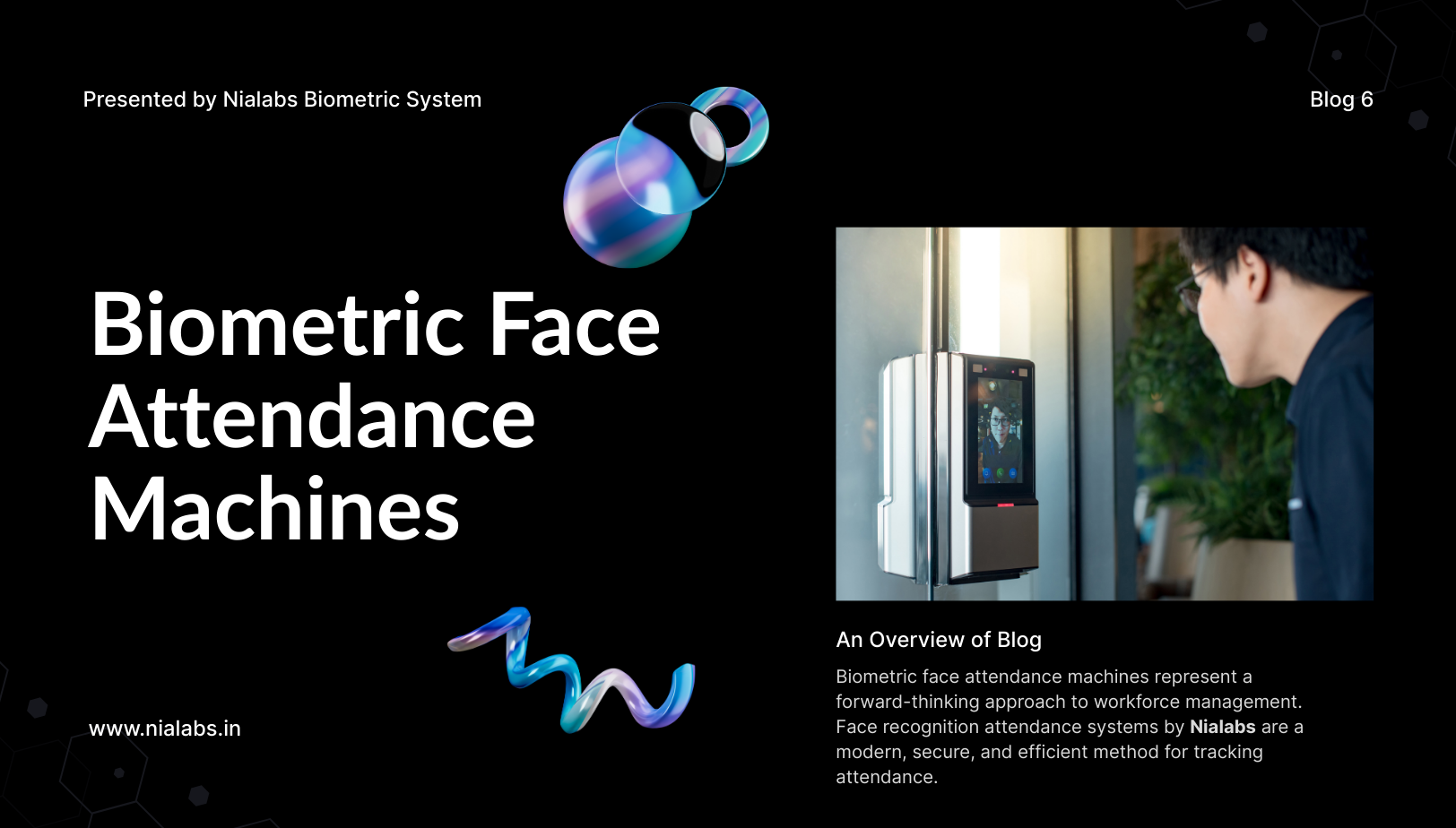
Biometric face attendance machines represent a forward-thinking approach to workforce management. Face recognition attendance systems by NIALABS are a modern, secure, and efficient method for tracking attendance. They offer several advantages over traditional systems, such as improved accuracy, security, and convenience.
Frequently Asked Questions (FAQs):
How does facial recognition improve workplace security?
Facial recognition ensures that only authorized personnel can access certain areas and mark their attendance. This minimizes the chances of unauthorized access and “buddy punching.”
What happens if the system fails to recognize an employee's face?
In rare cases, if the system fails to recognize an employee's face, backup measures like manual verification or multi-factor authentication can be used.
Do you know if a face attendance machine works in low light?
Modern biometric face recognition systems come with infrared sensors that allow them to work even in low light.
Can biometric face attendance machines be integrated with other software?
Yes, most modern biometric systems can be integrated with payroll, HR management systems, and other workplace software to streamline operations.
✍️ Muskan Singh
Hi, I'm Muskan Singh, a content writer passionate about exploring how technology, EdTech, and SaaS are shaping the...
Show More📞 Get In Touch
We'd Love to Hear From You!
✍️ Muskan Singh
Hi, I'm Muskan Singh, a content writer passionate about exploring how technology, EdTech, and SaaS are shaping the...
Show More📞 Get In Touch
We'd Love to Hear From You!
Related Blogs
Top 10 Biometric Device Manufacturers in India
Biometrics is now the standard for identity verification, attendance monitoring, and access control in India. As companies digitize and workspaces evolve into hybrid and flexible models, the demand for reliable, automated, and secure biometric solutions is on the rise.
All-in-One HR Platforms: The Ultimate Solution for Payroll and Attendance Management
An all-in-one human resource platform provides seamless management of payroll operations while tracking attendance for increased operational efficiency and accuracy.
How Biometric Attendance Machines Are Revolutionizing Employee Attendance Tracking
Discover how biometric attendance machines revolutionize employee attendance tracking with accuracy, security, payroll automation & workforce efficiency.