

Blogs
Home
📋 Table of Contents
Biometric Attendance for Multi-Location Businesses
22 May, 2026
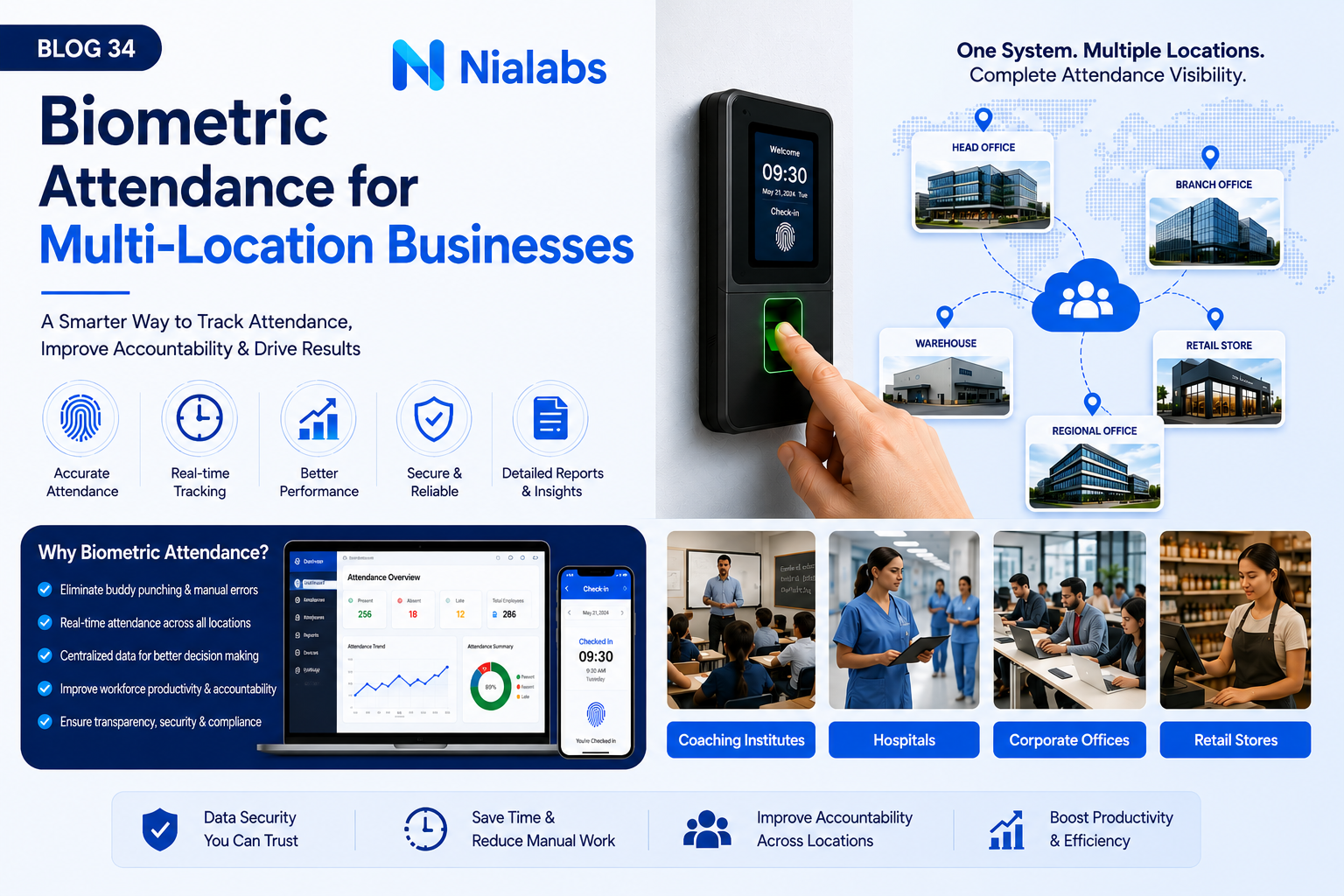
Employee attendance across different offices, branches, or locations is one of the most bothersome day-to-day operational problems for any business that is scaling in India. Any traditional attendance mechanism-punched cards, manual ledgers, or even simple digital logs- cannot function the moment your employee is across different cities. Human errors mount up, payroll is essentially a guessing game, and HR staff waste hours compiling and matching data that should have been automatically calculated
A biometric attendance system fixes it right at the source. Below is how biometric attendance for multi-location businesses are adopting it for uniformity, accuracy, and total management over the manpower.
Why Multi- Location Attendance is a Different Problem Altogether
A business with one physical office doesn’t require anything complex in terms of attendance. Once you begin to spread your operations across cities- even across different floors of a building- things become significantly more complex.
HR managers also face the following issues: varying data formats from various locations, delays in combining reports, lack of real-time visibility into the locations of each employee. Detecting unauthorized proxy attendance becomes more challenging when managers cannot physically monitor every location. Payroll data contains errors as it takes time for time attendance information to be submitted. Establishing and proving compliance with internal or external auditors.
A biometric attendance system solves all these at once by having a common, hardware-based database. It works in the same manner, irrespective of the physical location.
What Biometric Attendance Looks Like at Scale
A typical set-up in a modern large business with multiple branches will have:
-
A fingerprint or Face Recognition attendance system to monitor the entry and exit of employees to each of the branches.
-
A central cloud-based attendance system for multiple branches' dashboards, where all attendance information can be retrieved by HR and managers.
-
Real-time sync so clock-in information is updated instantly, rather than processed at the end of the day batch files.
-
Access control system based on role, so branch managers can only view their specific team’s data, while seniors can get a complete overview.
Nialabs is just this sort of integrated package, biometric hardware combined with a system that links all the hardware on your network into one centralised attendance management system.
Key Benefits for Multi-Location Operations
-
Accurate, Location-stamped Attendance Data:
Each clock is linked to a specific device and a physical location. Not only will payroll know that a staff member clocked in, but they will know it was a specific branch of your business. Businesses that require employees to travel between different branches will find that the specificity of this system eliminates errors in paying employees where location-specific allowances and shifts apply.
-
Elimination of Proxy Attendance:
Biometrics require physical presence; neither a face nor a fingerprint can be substituted with another’s (important in a multi-location context). Nialabs liveness detection adds even more security by countering any false presence achieved via pictures or pre-recorded videos.
-
Real-Time Visibility across the Organisations:
There is no need for managers to wait to be sent or have branch attendance data uploaded via email. Management sees this information in real-time from the main dashboard and immediately identifies trends- which branches have consistently high levels of late staff, or where overtime is accruing at too high a rate.
-
Ease in Payroll Calculation:
There is no need to gather reports from many Excel sheets, as the time data is directly imported into the system. This significantly minimizes calculation errors and time in payroll processing.
-
Audit-Ready Compliance Records:
If your organization undergoes a labor law compliance audit, the outcome of this audit is entirely reliant upon the time and attendance evidence you can present and defend. By recording tamper-proof, time-stamped biometrics within an organized database, generating this defense is more straightforward.
Integrating Biometric Attendance with Existing HR & Payroll Systems
A key concern that organizations commonly bring up is compatibility with existing HR software or biometric attendance integration with payroll. This is a real operational, not just a technical question.
The Nialabs system is designed for integration. This means it is able to connect with standard HR & school ERP software. Data relating to attendance will feed directly into payroll processing, leave management, and employees' database information. You will not need to replace your entire software system, as it complements and works with existing ones. Even for companies that have varying software systems from branch to branch, Nialabs multi-location attendance solution will be able to support such discrepancies, and at the same time, present harmonized consolidated results at the main branch.
Managing the Rollout across Multiple Sites
While installing biometrics attendance in several sites may necessitate more planning then single site installation, it’s nowhere as complex as most businesses imagine it to be.
HR departments can slowly adapt to the system by starting with one or two branches and progressing. Nialabs supports this through its installation and onboarding process, as well as technical support for every phase. The setup process (employee and device setup) takes place at the location that is starting on the system starts, so there is no operational dispute.
It also offers GPS attendance tracking without the need to have a fixed biometric device at every location, suitable for external sites or warehouses. Especially useful for companies in the logistics, construction, and field service sectors, etc.
Frequently Asked Questions for Multi- Businesses
-
What if a biometric machine is disconnected from the internet?
Nialabs devices save attendance locally in the biometric attendance machine and get uploaded to the cloud when the connectivity is resumed. There will be no data lost.
-
Can the branches have varying shift patterns?
Yes, the shift patterns can be location-specific, so each branch can have a different shift pattern and still all the data is consolidated at the reporting level.
-
How much time does it take to onboard staff in all locations?
Enrolment takes just a matter of minutes per employee. For big teams, Nialabs can support bulk enrollment to reduce system downtime during rollout.
-
Is biometric data kept safe?
Nialabs implements data security procedures and adheres strictly to all data security standards and guidelines in place. Biometric templates are kept encrypted in databases according to the applicable data protection laws.
Conclusion
A multi-location business requires an attendance infrastructure that grows along with them, consistent across the branches, accurate data, and centrally administrable and manageable. Nialabs provides both, starting from installing the hardware to providing the combined report.
Are you still keeping track of employees in all your locations with a manual and error-prone system? You need to upgrade your multi-location biometric attendance system right away.
✍️ Muskan Singh
Hi, I'm Muskan Singh, a content writer passionate about exploring how technology, EdTech, and SaaS are shaping the...
Show More📞 Get In Touch
We'd Love to Hear From You!
✍️ Muskan Singh
Hi, I'm Muskan Singh, a content writer passionate about exploring how technology, EdTech, and SaaS are shaping the...
Show More📞 Get In Touch
We'd Love to Hear From You!
Related Blogs
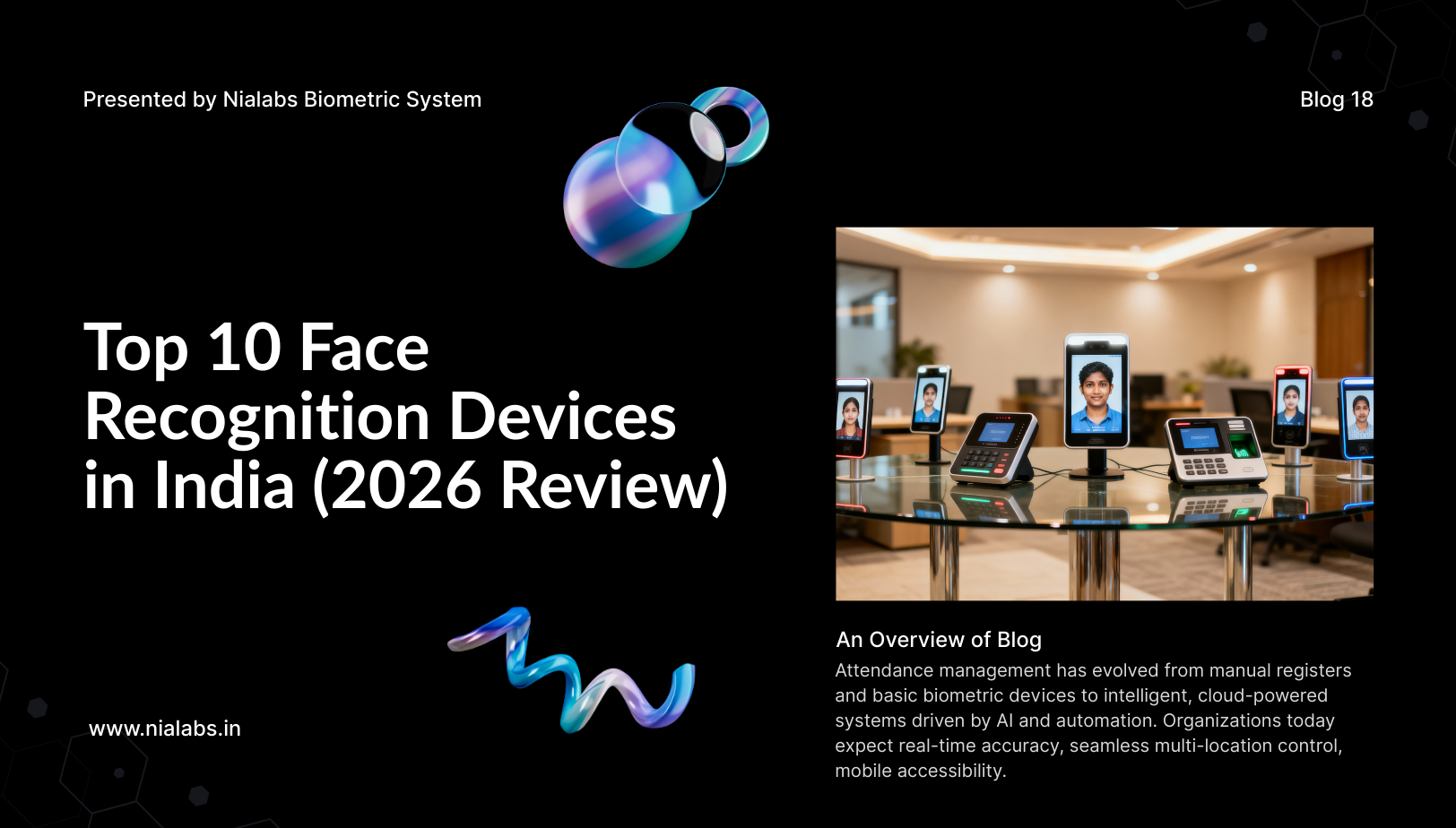
Top 10 Face Recognition Devices in India (2026 Edition)
Face-recognition attendance devices have become extremely popular across schools, offices, and institutions in India. They offer contactless, touch-free attendance, eliminate proxy marking, and deliver fast, accurate, tamper-proof attendance logs - all in real time.
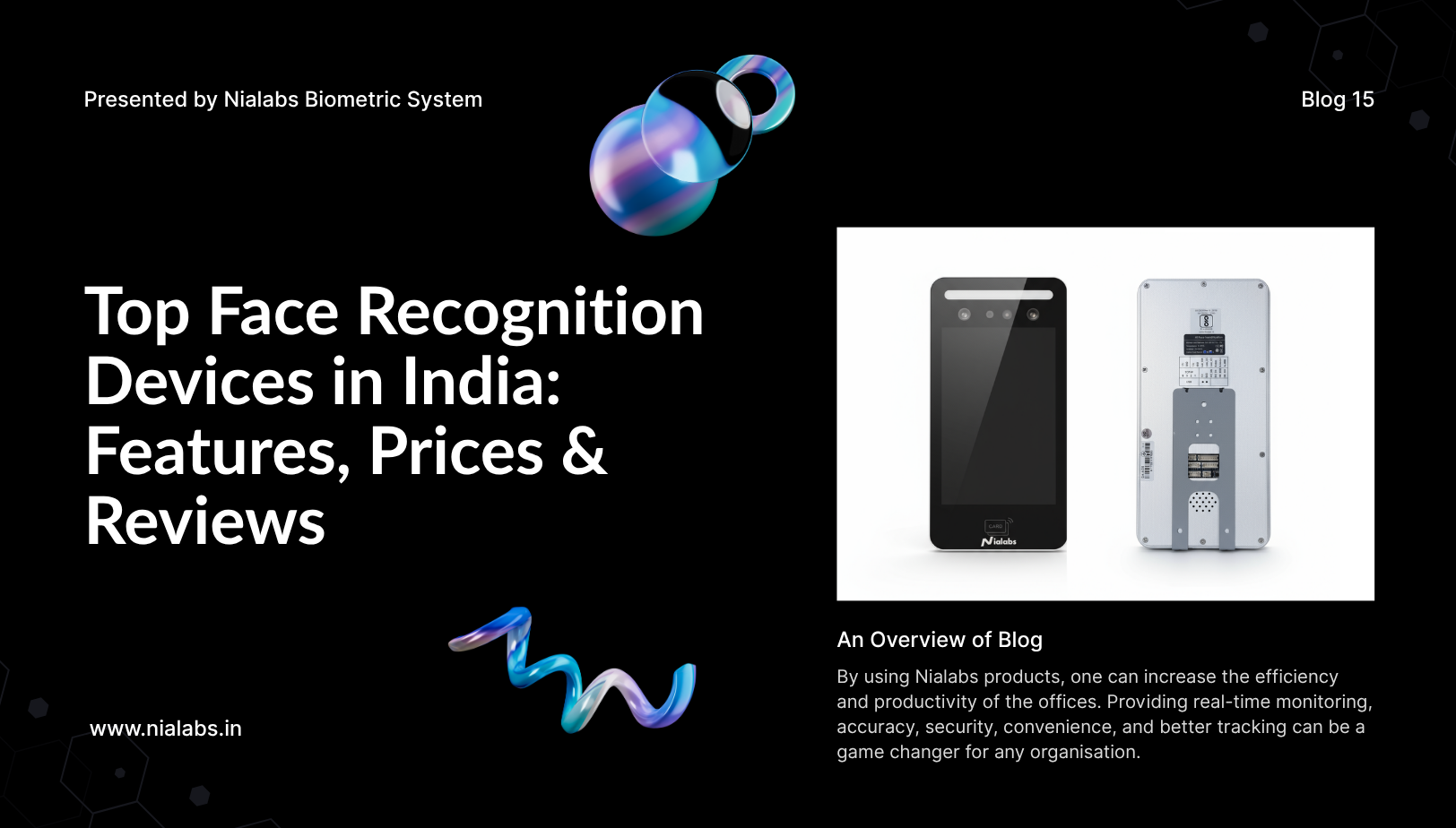
Top Face Recognition Devices in India – Features, Prices & Reviews
Now, with face recognition technology, attendance and access control are simple and intelligent processes. Contactless attendance systems have replaced conventional systems in schools, offices, factories, and hospitals. They are fast, precise, and clean, thus suitable for contemporary work environments.
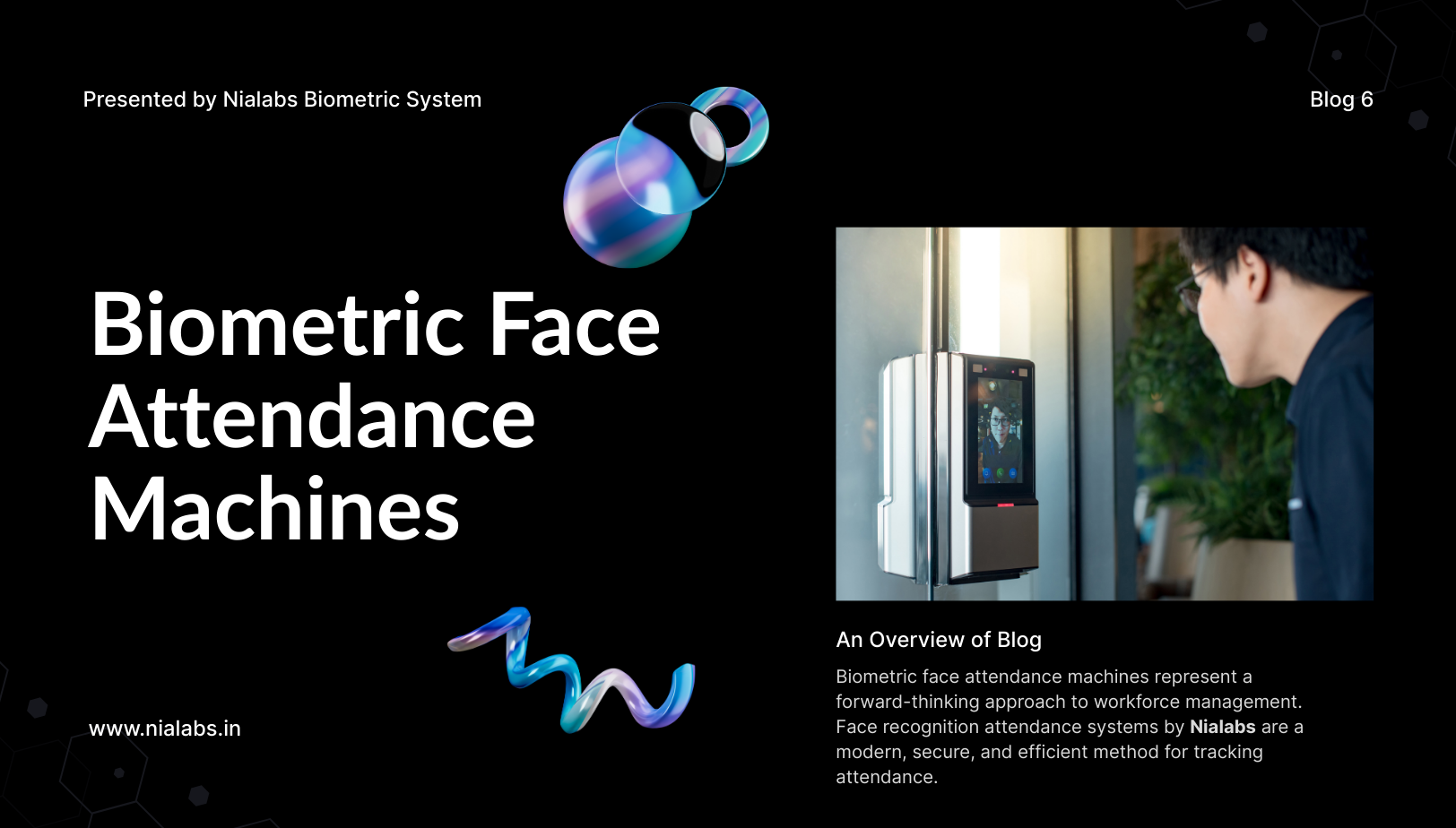
The Role of Face Attendance Machines in Modern Workplaces
Face attendance machines have become a vital part of modern workplaces, offering a secure, contactless, and efficient way to track employee attendance. Using advanced facial recognition technology, these systems eliminate the need for traditional methods like manual registers, ID cards, or fingerprint scanners, reducing time theft and proxy attendance. They enhance workplace productivity, improve accuracy in payroll processing, and support hygiene by minimizing physical contact—an especially important factor in post-pandemic environments. With real-time data tracking, seamless integration with HR software, and high-level security, face attendance machines are transforming how organizations manage workforce attendance in a smarter and more reliable way.