

Blogs
Home
📋 Table of Contents
Bus Attendance System: How GPS and Biometrics Improve Student Safety in India
18 May, 2026
The most vital, and perhaps most often overlooked, component of the school management system in India is the transportation of students. Considering the staggering number of children who attend public and private schools, many of these children utilize school buses as their principal means of transit. With more and more schools realizing that ensuring every child gets on and off their assigned bus, and notifying appropriate personnel about the location in real-time, is not a luxury but an operational imperative.
This need cannot be met by conventional attendance systems. Schools are relying on GPS tracking and biometrics for an accurate bus attendance system, accountable and transparent transportation of students, and the improvements are evident.
The Problem with Traditional Attendance
Manual bus attendance processes can lead to constant operational inefficiency. The process of attendance recording is performed by the teacher or a bus attendant with the use of paper-based attendance sheets. This process offers no validation, no real-time updates, and no accountability.
Some errors typically include false boarding inputs, students being missed on multi-stop buses, and no automatic notification process for the parents or administration upon discovery of an error.
From an administrative perspective, there is no recorded information about which students boarded which bus, when, or at what stop. It is difficult to use this information for incident reporting, keeping compliance documentation, or quickly responding during an emergency. This becomes harder to track as school size increases.
Impact of GPS Tracking on School Bus Safety
In-built GPS devices in the school bus tracking system in India are the component that allows school authorities, parents, and employees to have access to the live location information during travel.
-
Live Route Monitoring:
School authorities would be able to track each school bus on the specified route, detect discrepancies, and get an immediate notification of any deviation.
-
Instant Parent Notifications:
Parents will receive SMS/push notification when the child boards on/off the bus, helping you to ease your worries and also to take action when required.
-
Geofencing Alerts:
Administrators define virtual fences around school grounds or pick-up zones. If a bus is detected moving in/ out of the specified zone, it will send a notification to the concerned persons.
-
Trip History:
All of the trips taken, including speed, location of stop, etc. Can be recorded by the GPS. This can be used for auditing, or crash investigation, and help the future to reroute to improve safety or speed of delivery.
Biometric Attendance- Moving Beyond GPS:
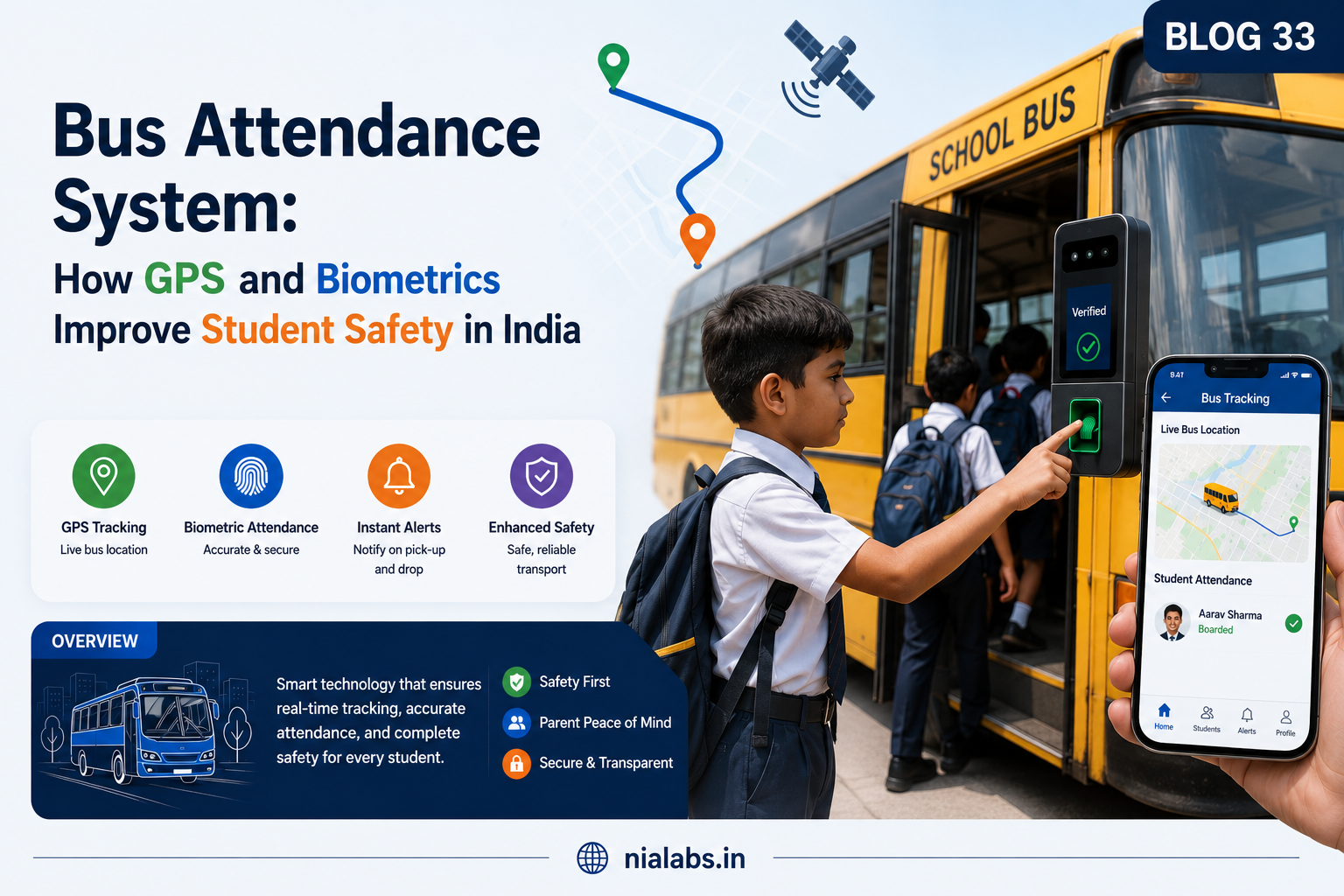
While GPS identifies the bus location, biometrics ensures a positive ID for each student safety in school transportation. A child might stand near the bus stop without boarding, or board the wrong bus. Biometric verification (via fingerprint scanner or RFID smart cards) provides individual identification at each boarding point.
By the time a child places their finger on the bus scanner, it’s verified and logged in real time, synced to school databases, and a parent's phone. This is the new standard of care when it comes to student transportation.
Smart school bus systems have already been implemented with great success in school districts across Karnataka, Telangana, and Maharashtra, demonstrating a virtually zero attendance mismatch, as well as a marked decrease in parent complaints about student transportation safety in India.
Benefits for Indian Schools
-
Completely avoids manual errors & false attendance logging (Proxy boarding)
-
Prevents unauthorized boarding of individuals (non-students)
-
Creates tamper- proof, time-stamped records of boarding & alighting
-
Facilitates instant notifications to parents via mobile apps, ensuring peace of mind
-
School administration can gain critical transport analytics & create audit trails
-
Facilitates rapid, streamlined reaction during emergencies and transit disturbances
-
Aids schools in ensuring compliance with CBSE & state transport safety rules
Deployment Considerations
For the implementation of a GPS-biometric attendance system in India, schools need to consider several factors, such as robustness of devices against various environmental conditions, network connectivity in rural parts with weak network signal, data privacy compliance with the Indian Digital Personal Data Act (DPDPA), and staff training.
In terms of infrastructure, the cloud-based platforms will be better suited to India, having to account for both connectivity issues and offline sync, built not for metros only but for the whole of India.
Powering Safer School Buses with Nialabs
Nialabs has developed specific attendance and school bus safety solutions that are built for the Indian school environment. From GPS tracking for school buses to the most secure student verification system using biometric machine technologies, Nialabs brings all these together into one easy-to-manage system that can be accessed by school administration, transport staff, and parents. Working with limited networks and scalable to any school size, Nialabs enables schools to shift from reactive incident management to proactive student safety.
What Nialabs Provides for Bus Attendance Management
-
Live GPS Tracking:
Parents/Admins are able to check the current location of the bus on the app/web portal.
-
Biometric boarding Check:
Students ' sign in / sign out ' using biometrics (fingerprints, RFID, etc.) when entering and leaving the bus.
-
Automated parents' notification:
SMS and app notifications to the parents in real time when the student boards or deboards the bus.
-
Attendance dashboard centralized:
Admin can track all buses, routes, and student data in one place in real time.
-
Geofencing Alert:
Notification is sent when the bus moves out of the route or crosses the permitted zone.
-
Offline sync:
When network quality is poor, the attendance is saved and then syncs once the network is restored.
-
Comprehensive Audit Trails:
Time-stamped boarding records can be traced.
The Road Ahead
The confluence of GPS, biometrics, and AI-driven analysis marks a new frontier in the area of school transportation safety, with systems in the future to accurately forecast travel delays with real-time traffic analysis, identify any irregular patterns in student travel, and interface with overall School ERP and Learning Management Systems.
As India makes a rapid transition to digital learning, with NEP 2020 leading the charge, the smart school bus system will form an integral part of the Indian school experience, as integral as the classroom and the textbook. As the technology is present and it is the requirement of today, Indian schools need to adopt GPS and biometric bus attendance systems not in the future but today itself.
✍️ Muskan Singh
Hi, I'm Muskan Singh, a content writer passionate about exploring how technology, EdTech, and SaaS are shaping the...
Show More📞 Get In Touch
We'd Love to Hear From You!
✍️ Muskan Singh
Hi, I'm Muskan Singh, a content writer passionate about exploring how technology, EdTech, and SaaS are shaping the...
Show More📞 Get In Touch
We'd Love to Hear From You!
Related Blogs
Biometric Systems Explained: Definition, Technology, and FAQs
Biometric systems use unique physical and behavioral traits like fingerprints, facial features, and iris patterns to accurately identify and verify individuals. They are widely used across government, business, and everyday applications to enhance security, reduce fraud, and enable fast, reliable authentication.
Top 10 Biometric Attendance Systems in India 2026
top 10 biometric attendance systems in India for 2026. Compare AI-based, cloud-enabled, and contactless solutions designed to improve accuracy, prevent time fraud, and streamline payroll and HR management for businesses of all sizes.
How does a Biometric Attendance System work?
Learn how a biometric attendance system works, its components, process flow, and benefits for schools, offices, factories, and enterprises.