

Blogs
Home
📋 Table of Contents
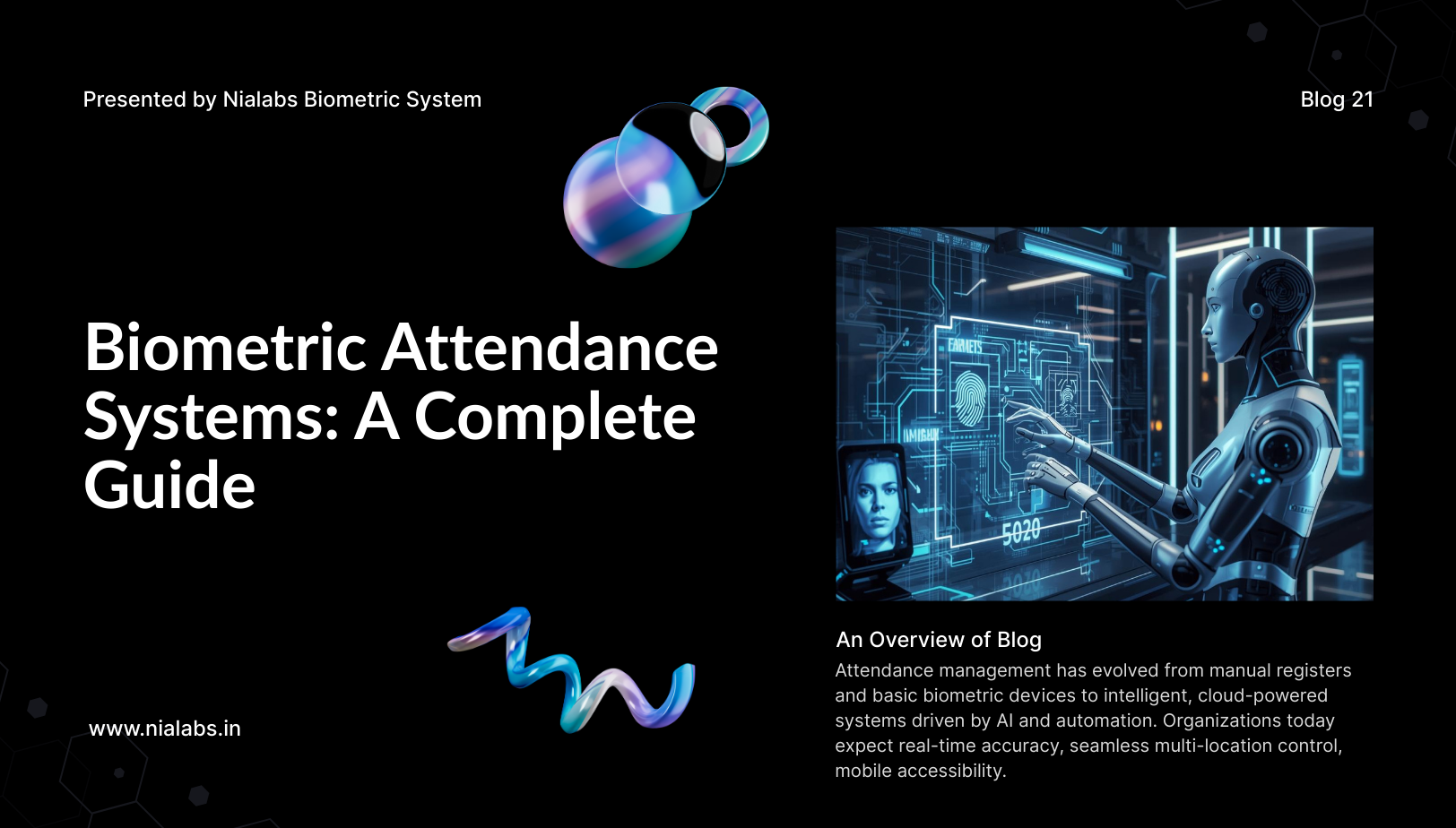
Biometric Attendance Systems: A Complete Guide
08 Jan, 2026
Monitoring attendance is a fundamental aspect of managing employees. Despite this, organisations are still experiencing challenges such as data inaccuracy, attendance tampering, payroll discrepancy, and manual supervision. Conventional methods of attendance checking were not precise or secure enough to be used in such dynamic settings.
A Biometric Attendance System-based solution which make sure that ensures accurate and digital attendance with an additional benefit of real-time monitoring. With unique human identifiers, biometric systems tackle attendance issues to eliminate attendance fraud, streamline workflows, and enforce workforce discipline. Here, you get to know all the details of the biometric attendance system working, types, features, advantages of the biometric system of attendance, as well as its application in diverse industries and organizations.
What is a biometric attendance system?
A biometric attendance system operates as an automated process in which an individual’s identity is authenticated through his/her unique biological traits, like fingerprints, facial, iris, or voice, and attendance is marked online. As these features are individual-specific, they result in precise and reliable attendance.
Unlike conventional attendance systems that use cards, pins, or registers managed manually, biometric systems prevent proxy attendance and tampering of records. They provide live and reliable attendance data and can be connected to payroll, HRMS, ERP, school management software, etc., which makes them the ideal choice for the modern-day organization.
How biometric attendance systems work?
Biometric attendance systems are based on a secure and structured flow of operations that are used to confirm identity and generate attendance reports accurately.
-
Biometric Enrollment:
The procedure starts with enrollment when an individual’s biometric data, a fingerprint scan or facial image, is captured. This is transformed into a digital biometric template and is encrypted, then stored in the system database.
-
Authentication & Verification
When a person tries to check in, the system obtains the live biometric data via a sensor or camera. The captured data is then analyzed by sophisticated algorithms against the stored templates to perform the identity verification.
-
Attendance Record
Upon completion of the validation process, the attendance is registered automatically with date and time, with user ID and location information.
-
Data Storage and Synchronization:
Attendance information is kept either on local servers or in the cloud and synchronized in real time between systems.
-
Reporting & Integration:
The collected data is processed to produce attendance reports and is integrated with payroll, human resources, or enterprise resource planning (ERP) systems to directly calculate pay, track compliance, and conduct workforce analysis.
With all this automation in place, attendance is perfect and takes no manual work.
Types of biometric attendance systems
A biometric attendance system is divided based on the kind of biometric modality it uses. Each type is intended for varying system requirements of operation:
-
Fingerprint Attendance Systems:
Fingerprint-based systems identify users by reading their fingerprints.
They have been popular for a long time for their low cost, high accuracy, and simple implementation.
-
Face Recognition Attendance Systems:
A facial recognition system has AI cameras that capture and extract facial features. They enable contactless check-in at crowded or hygiene-sensitive workplaces.
-
Iris Recognition Attendance Systems:
Iris-based systems use authentication based on a unique pattern of the iris. They are incredibly accurate and used in high-security situations.
-
Palm Vein Attendance Systems:
Palm vein technology captures the patterns of the veins under the skin with the help of infrared light. These systems are more secure and are also immune to superficial damage.
-
Voice-Enabled Attendance Systems:
Voice recognition systems identify persons by their voice. They are useful in telephone or voice interaction environments, but are sensitive to noise.
-
Mobile Biometric Attendance Solutions
Mobile attendance systems based on biometric technology allow attendance to be registered on the mobile phone with fingerprint authentication or facial recognition, having the capability of geo-fencing and time-stamping.
A few organizations choose a hybrid biometric system in terms of cost, convenience, and security.
Key features of biometric attendance systems
The advanced biometric attendance system is equipped with the complete features of biometric attendance system required for efficient and scalable operation.
-
Unique Identity Authentication:
Confirms that attendance is only marked by an authorized person.
-
Real-Time Attendance Monitoring:
Enables real-time monitoring of employee/student attendance at multiple sites.
-
Cloud Infrastructure:
Provides secure storage and auto backup, and the attendance data can be accessed from anywhere.
-
Shift & Policy Management:
Support for multiple shifts and work hour flexibility, including late arrival and overtime rules.
-
Multi-Location Management:
Provides centralized monitoring of attendance in branches, sites, or campuses.
-
Integration with Business Systems:
Smoothly interfaces with payroll software, HRMS, ERP, or school ERP solutions.
-
Automated Dashboards and Reports:
Produces attendance reports with analytics for daily, weekly, and monthly periods.
-
Mobile & Web Access:
Attendance information is accessible via web dashboards and mobile applications.
-
Data Protection & Compliance:
Sensitive biometric data is protected by encryption and access controls.
Benefits of a biometric attendance system
Implementing a biometric attendance system can provide real benefits for any organisation, be it is a small one or has a large number of employees.
-
Detailed Attendance Records:
Biometric authentication eliminates the errors occurring due to manual input and duplicate records.
-
Stopping Attendance Fraud:
Proxy punching and buddy punching are not possible with the attendance tracking system.
-
Payroll Accuracy:
With accurate attendance information, employers are able to make accurate payments to employees, calculate overtime correctly, and manage leaves appropriately.
-
Less Admin Burden:
The process is getting easier for HR with automation, and there is no more manual reconciliation.
-
Better Workforce Discipline:
Employees are more disciplined, more adherent to the schedule, and have their attendance intensively monitored.
-
Real-Time Decision Making:
Managers have real-time visibility into the availability and attendance of their workforces.
-
Scalable & Future Ready:
Biometric systems scale with organisations and enable digitisation and transformation initiatives.
-
Long-Term Cost Efficiency:
The upfront cost can be significant, but so are the long-term cost savings of operation.
Use Cases of Biometric Attendance Systems by Industry
-
Corporate offices & IT companies
It enables the monitoring of the attendance of employees, the hybrid working model, flexible working hours, and distributed teams.
-
Production & Industrial Units
Allows shift attendance management, overtime calculation, and can be used in highly regulated industries.
-
Schools
Monitors student and staff attendance and school ERP integration.
-
Health and Hospital Services
Staffing, scheduling, management, rotating shifts, and tracking compliance with attendance policies are implemented.
-
Retail & Hospitality
It monitors attendance at multiple locations and handles complex work shifts.
-
Construction & Field Workforce
Mobile biometric systems without geo-fencing can also be used for on-site attendance verification.
Every sector can take advantage of tailored biometric attendance flow processes, which enhance accuracy and responsibility.
Biometric Attendance System vs Traditional Attendance Methods
Traditional attendance methods are based on physical work, attendance registers, or portable instruments (for instance, cards or passwords). These approaches are liable to errors and manipulation, as well as inconsistent data.
Biometric attendance systems are automated and secure, and allow for real-time attendance monitoring. They eliminate fraud, reduce administrative tasks, and provide accurate information for payroll and compliance. For organisations wanting transparency, scale, and long-term efficiency, the answer is unequivocally that biometric systems are far superior to conventional systems.
Conclusion
Biometric attendance systems are now the backbone of modern workforce management. Using unique biological features, these systems offer the highest degree of precision, security, and convenience. They eliminate attendance fraud, make staffing easier, and provide real-time data to enable better decisions.
If you are an organisation that aspires to change the method of monitoring attendance and building a well-disciplined, analytics-based workforce, then biometric attendance systems are the seamless and future-proof answer.
FAQs
-
Is a biometric attendance system safe?
Yes, biometric data is encrypted and stored as digital templates, so security and privacy are quite good.
-
Can a biometric attendance system be integrated with payroll software?
Yes, biometric systems can be directly integrated with payroll, HRMS, and ERP systems.
-
Do small businesses benefit from biometric systems?
Yes, biometric attendance systems can be scaled up and adapted to suit the needs of any organization.
-
Do biometric systems support remote workers?
Yes, mobile biometric attendance solutions facilitate attendance marks for remote and field employees in a secure manner.
-
Which biometric method is the most popular?
Fingerprint and facial recognition have the highest adoption rates, as they represent the best combination of usability and accuracy.
-
Does the biometric attendance system need the internet to download or upload the attendance?
No, you can take attendance offline, and it will sync automatically when you go online.
-
Can a biometric attendance system be used for different shifts?
Yes, it supports multiple shifts/rotations and flexible schedules.
-
Can I use a biometric system for two or more locations?
Yes, you can manage attendance of multiple branches or sites with one system.
-
Does biometric attendance lead to better accuracy in attendance?
Yes, it records attendance by using unique biometrics, so the chances of error and manipulation are very less.
10. Is it possible to use a biometric attendance system in a busy place?
Yes, it is designed for high user traffic and to serve a high number of users in an efficient and fast manner.
✍️ Muskan Singh
Hi, I'm Muskan Singh, a content writer passionate about exploring how technology, EdTech, and SaaS are shaping the...
Show More📞 Get In Touch
We'd Love to Hear From You!
✍️ Muskan Singh
Hi, I'm Muskan Singh, a content writer passionate about exploring how technology, EdTech, and SaaS are shaping the...
Show More📞 Get In Touch
We'd Love to Hear From You!
Related Blogs
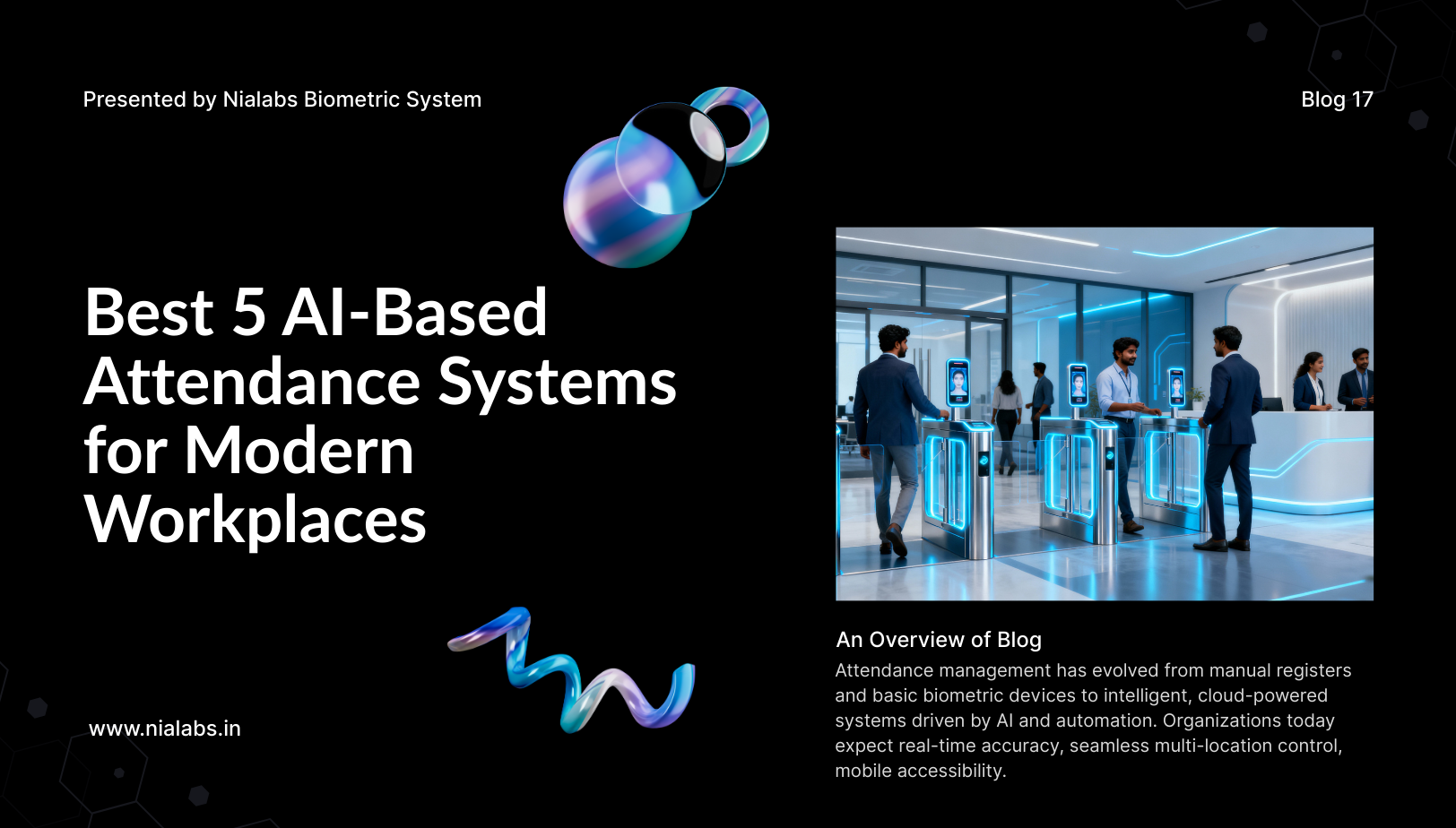
Best 5 AI-Powered Attendance Systems for Modern Workplaces
An AI-powered attendance system uses artificial intelligence and biometric/face recognition (or other biometric methods) to automatically identify employees and mark their attendance—replacing manual registers, swipe cards, or fingerprint scanners.
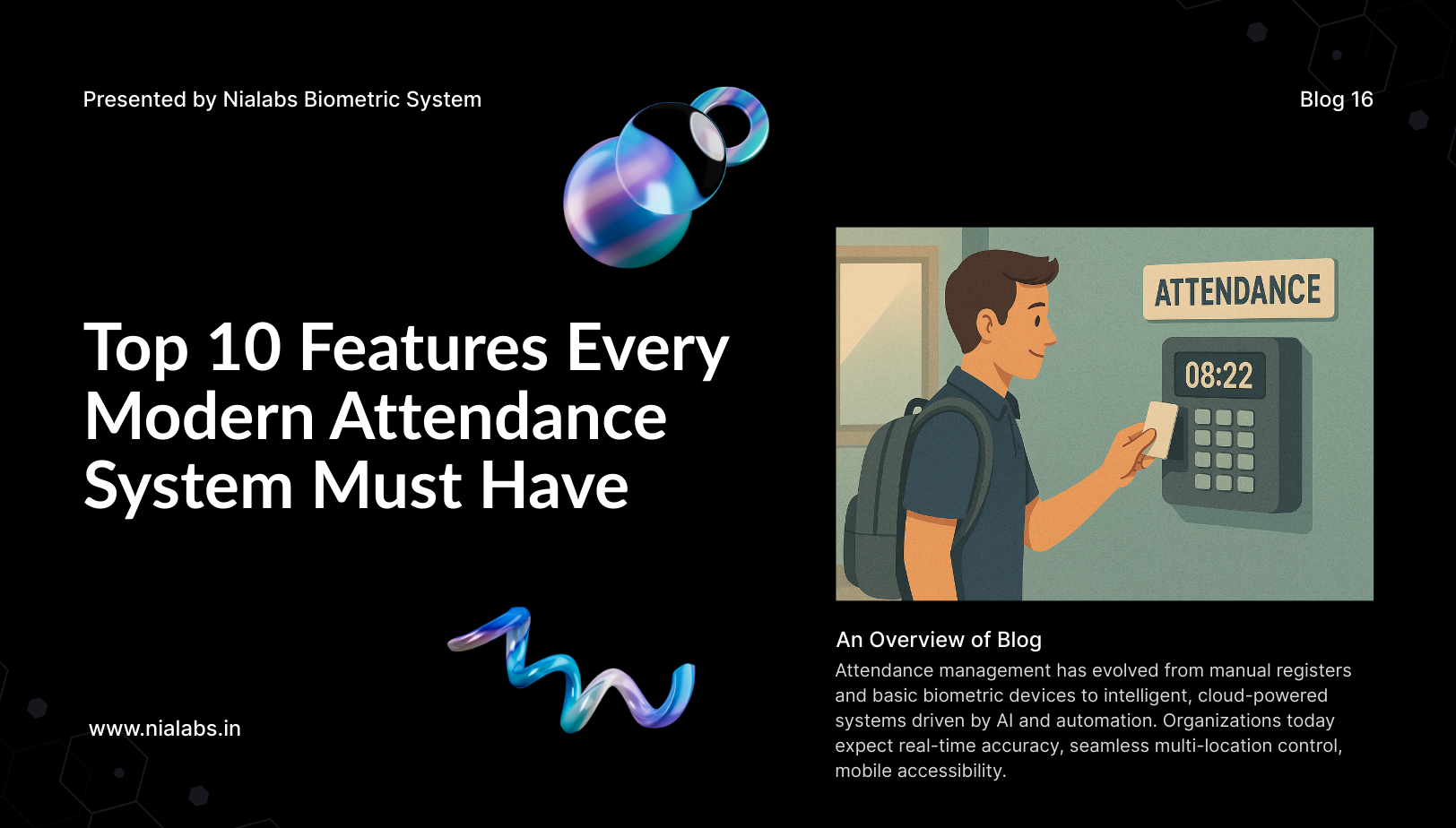
Top 10 Features A Modern Attendance System Should Have
Discover the top 10 features every modern attendance system should offer, including biometric tracking, mobile attendance, real-time reporting, cloud access, and seamless payroll integration.
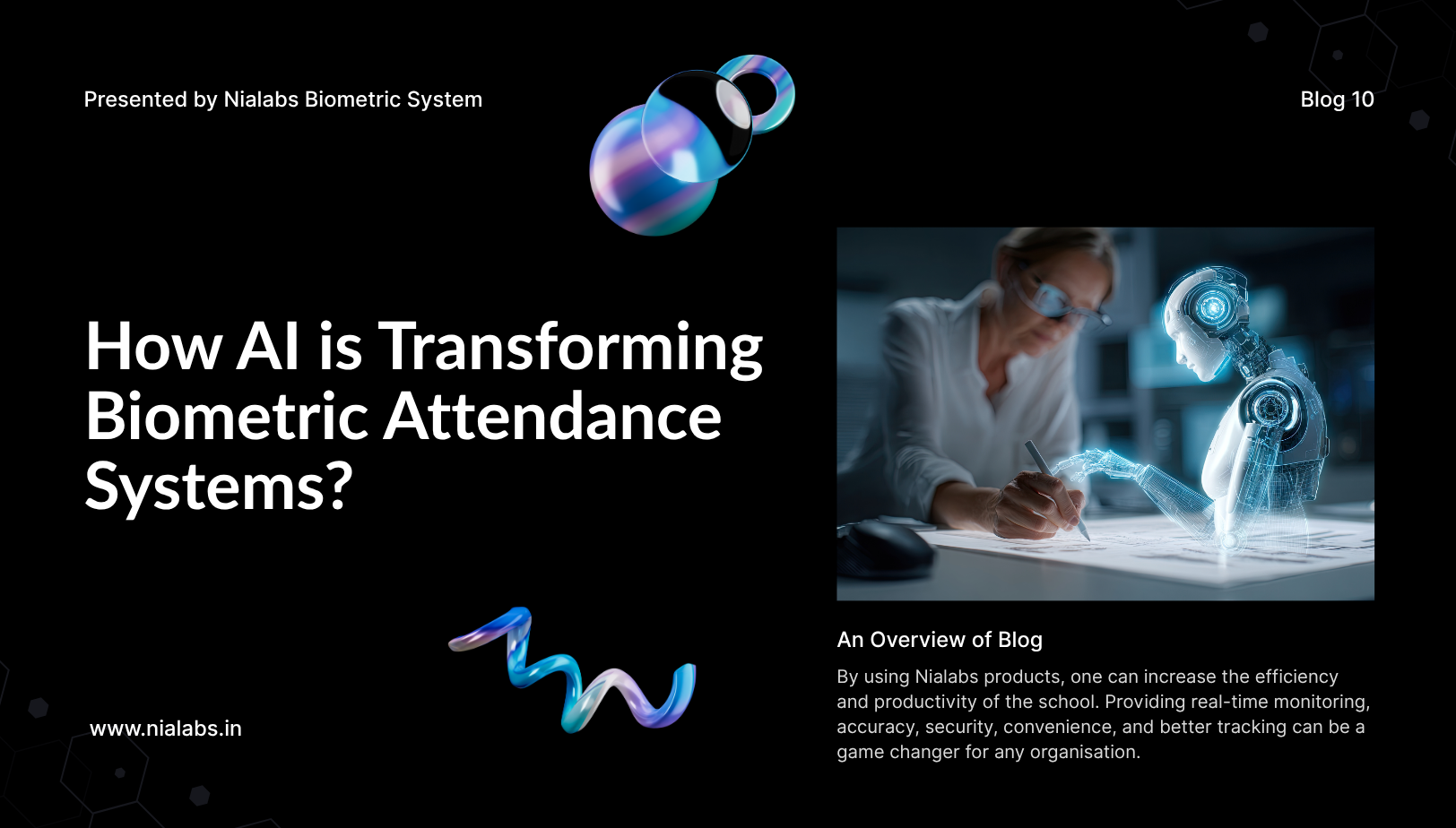
How AI is Transforming the Biometric Attendance System
Artificial Intelligence (AI) is revolutionizing the way biometric attendance systems operate, making them faster, smarter, and more secure than ever before. Traditional biometric systems relied solely on fingerprint or facial recognition to mark attendance. However, with the integration of AI, these systems now offer real-time facial recognition, live detection, predictive analytics, and cloud-based data management, ensuring accuracy and efficiency at every step.