

Blogs
Home
📋 Table of Contents
What is Liveness Detection and Why Your Biometric System Needs it
01 Jun, 2026
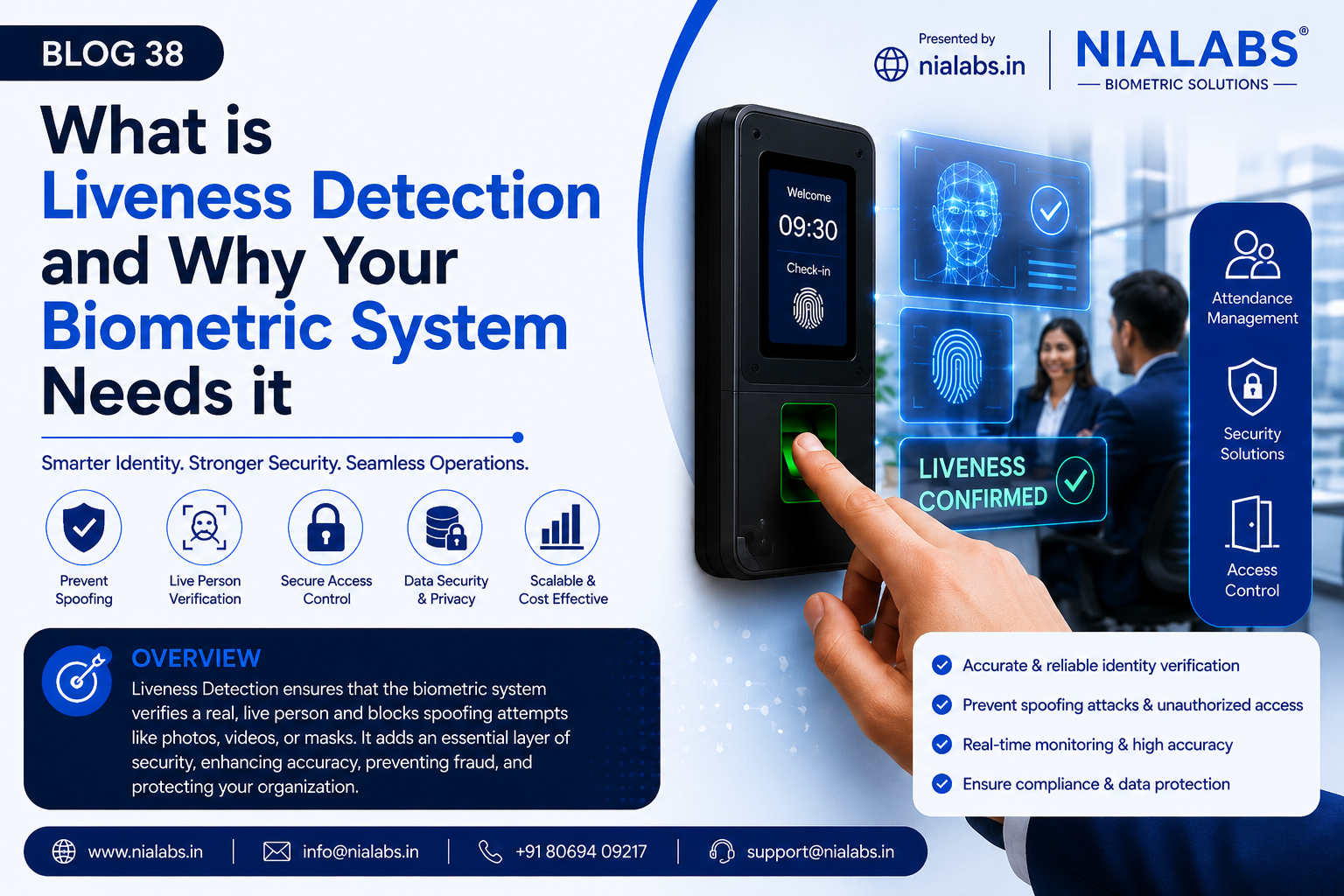
Liveness Detection is a security mechanism used to verify that a biometric image (of a face, fingerprint, or iris) is of a live human being and not a static image, such as a photograph, video, or plastic imitation. It is essential that all organizations, now implementing a biometric system, include liveness detection as a key security component.
Biometric attendance and access control systems are now mainstream for Indian businesses, schools, hospitals, and government institutions. However, with the rise in use comes the rise of one threat, i.e., spoofing attacks. Scammers use printed images, recorded videos, silicone
fingerprints, and 3D masks to trick biometric readers. Liveness detection removes this vulnerability entirely.
In this blog post, we have elaborated on what liveness detection is, how it works, what its various types are, and why your organization cannot complete its biometric attendance system without it.
What is Liveness Detection in Biometric Systems?
Liveness Detection (also known as Presentation Attack Detection-PAD) is the ability of a biometric system to distinguish between the actual living person and the fake one. Liveness detection is an extra intelligence element integrated into facial, fingerprint, or iris recognition systems.
In the absence of presentation attack detection, the biometric system only ensures that the input presented matches the one that is stored in the database. It fails to authenticate whether the present input is from a real person available during authentication time. Spoofing attacks take advantage of this shortcoming.
This detection method not only ensures the existence and biological presence of the person, but it also serves as a safeguard before giving out access/ recording. The entire authentication process thus becomes more robust and trustworthy.
What is Liveness detection?
Liveness detection methods integrate hardware sensors and software based on AI to detect signs of live person in biometric data.
The implementation may differ depending on the modality of the biometric.
-
In a facial recognition system, liveness detection may use analysis of micro expressions, eye blinking, head movement, skin texture, or depth mapping via an infrared sensor. The AI models are trained to determine if the face they are viewing has correct depth, has blood flow characteristics, and has random movements that neither a photonor ar video can correctly reproduce.
-
In the case of fingerprint scanners, they measure values like blood flow, elasticity of the skin, sweating patterns, conductivity of the skin, and many other biometrics, which a fake silicone model will not have.
-
In iris recognition, the detection of a live person measures the contraction and expansion of the iris upon a change in the amount of light present, a reflex reaction that is not possible with a picture.
For all of the above, the basic idea remains the same: AI and sensor input to verify that the biometric sample comes from a live person at the time of enrollment.
Types of Liveness Detection
When examining biometric solutions, organizations should consider the two forms of liveness detection:
-
Active Liveness Detection:
The user must carry out an action when authenticating: blink, move their head, smile, or look at a prompt on the screen. The liveness is then detected by determining whether the user actually moved naturally or not. This technique is very successful, but it adds one more step in the process.
-
Passive Liveness Detection:
It operates seamlessly in the background. It assesses the biometric data without any interaction required by the end-user. Sophisticated AI algorithms analyze reflections, textures, and depth of images in real-time. This provides a very intuitive experience and yet maintains robust anti-spoofing measures.
Most modern biometric systems today (even AI-based face recognition systems) employ these two methods in conjunction to provide extreme security with high speed.
Why Indian Organizations Need Liveness Detection Now
The rapid trend in India toward digital workplaces, smart campuses, and automated attendance tracking has introduced millions of employees and students to biometric systems. These systems represent a massive target for attendance fraud and hacking.
Let us analyze these examples, which often take place in the Indian organizational environment:
-
The employee takes a snapshot of his colleague and inputs it into the biometric attendance machine in order to log a proxy attendance on it without the liveness checking facility.
-
A visitor accesses a high-security area by presenting a high-quality photocopy of the authorized person’s face.
-
The student attends a class for a feeding in the photograph in a campus biometric machine.
All these examples could be prevented using liveness detection. Even a very expensive biometric system without liveness detection provides an illusion of security.
Besides combating fraud, the technology assists with compliance. With biometric security, India is increasingly moving towards more robust data protection laws. With the DPDP Act, institutions will need to provide a more secure mechanism for the collection of biometric data. Presentation Attack Detection serves as a technically verifiable protection that can serve as such a defense.
Liveness Detection and Attendance Accuracy
Apart from security, liveness detection contributes positively to the accuracy of attendance data. In contexts where proxy attendance is an ongoing problem, such as manufacturing floors, large corporate offices, schools, and other educational institutions, the liveness system will guarantee that each attendance data logged is the presence of an actual person.
The improved accuracy of attendance information also provides other advantages further up the process, such as more reliable payroll, better compliance with shifts, and a reduction in HR staff time spent chasing exceptions. This enhanced operational performance can result in significant cost savings for businesses with large workforces at multiple sites.
Liveness Detection Implementation in Nialabs' Biometric Solutions
Nialabs is building inherent presentation attack detection capabilities into its AI facial recognition and biometrics attendance solutions, ensuring that each login event is verified with a real, live person in attendance.
Nialabs face recognition system has been trained on passive and active liveness detection algorithms on heterogeneous data sets in order to achieve effectiveness in various light, skin, and environmental conditions required for individual Indian organizations.
From corporate offices to manufacturing plants, schools to healthcare establishments, Nialabs biometric systems provide an anti-spoofing biometric system, frictionless authentication at all locations. By integrating with HR, payroll, and access control applications, liveness-authenticated, correct attendance records are fed seamlessly into the workflow.
Nialabs can also conduct an assessment of your biometric security, implement a robust solution, and help you to support and maintain your biometric system for accurate and compliant performance over the long term.
Read more about Nialabs Biometric systems, incorporating liveness detection at Nialabs.in
Conclusion
Liveness detection differentiates a biometric system from appearing to be secure to actually being secure. In an increasingly sophisticated spoofing landscape, companies implementing biometrics in their attendance and access control systems do not have them protected from this vulnerability.
For Indian businesses, institutions, and governmental organizations investing in biometric technology, liveness detection is not an optional accessory; it’s a fundamental aspect for deploying biometric technology responsibly and effectively.
An attendance management system that doesn’t include liveness detection in biometrics is inherently inadequate.
✍️ Muskan Singh
Hi, I'm Muskan Singh, a content writer passionate about exploring how technology, EdTech, and SaaS are shaping the...
Show More📞 Get In Touch
We'd Love to Hear From You!
✍️ Muskan Singh
Hi, I'm Muskan Singh, a content writer passionate about exploring how technology, EdTech, and SaaS are shaping the...
Show More📞 Get In Touch
We'd Love to Hear From You!
Related Blogs
Biometric Systems Explained: Definition, Technology, and FAQs
Biometric systems use unique physical and behavioral traits like fingerprints, facial features, and iris patterns to accurately identify and verify individuals. They are widely used across government, business, and everyday applications to enhance security, reduce fraud, and enable fast, reliable authentication.
Top 10 Biometric Attendance Systems in India 2026
top 10 biometric attendance systems in India for 2026. Compare AI-based, cloud-enabled, and contactless solutions designed to improve accuracy, prevent time fraud, and streamline payroll and HR management for businesses of all sizes.
How does a Biometric Attendance System work?
Learn how a biometric attendance system works, its components, process flow, and benefits for schools, offices, factories, and enterprises.