

Blogs
Home
📋 Table of Contents
Biometric Attendance System for Factories & Manufacturing Units: Complete Guide
25 Jun, 2026
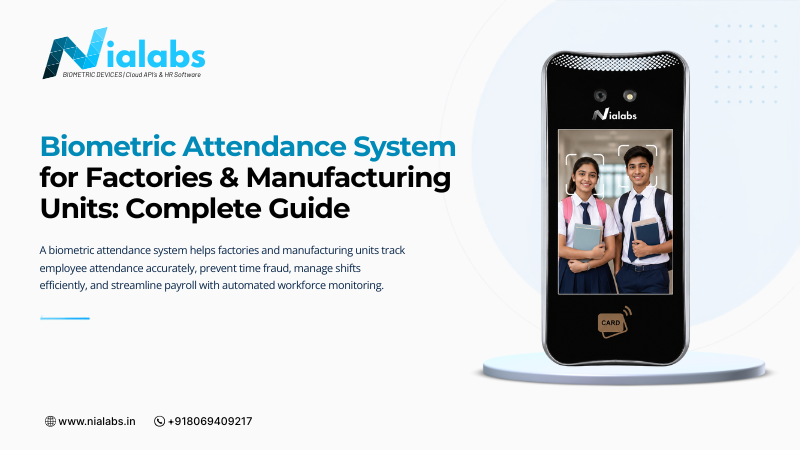
One of the consistent challenges facing manufacturing units in India has been attendance tracking across shifts, contractors, and shop floors whilst eliminating time theft. Manual registers and card swipes can often enable buddy punching, proxy attendance, and payroll issues. Our biometric attendance system for factories ensures that attendance is linked to a unique identity and fraud becomes near impossible while labour laws compliance is maintained.
Why Factories Need Biometric Attendance Systems
Operations are not the same at factories, unlike offices. A variety of schedules, shift rotations, contract workforce, and a larger number of staff make a manual card-based access system very difficult to manage without error. A handful of features can be extremely significant when looking at the manufacturing vertical.
-
High contract labor turnover:
Companies hire seasonal and contractual staff in plants. Using biometric enrollment guarantees every worker has an identity and works for one specific company. Even the staff turnover can’t prevent accurate recording.
-
Multi-shift operations:
The staff in multi-shift attendance management just check in and check out on the biometric device, and then no manual check/reconciliation is required for staff in different shift time recording.
-
Statutory Compliance:
The Factories Act 1948 and several other state labor legislations mean that accurate record keeping of employee working hours is mandatory. With biometrics, there is assurance of a ready-to-audit time log.
-
Payment disputes:
Reduce cases of absenteeism or overtime claims with a log backed by secure biometrics data rather than physical attendance registers.
Going beyond In time: The Process from Clock In to Dashboard
Clock In is carried out either using your fingerprint/ face impression through finger scanners/ facial scanners at access points and inside the production floor. Your impressions would be scanned by the device and then checked with the stored impression, and then logged in and synced in the Cloud/ server so that all the Plant Managers and HR personnel get an update instantly across production facilities.
Key Features to Look For
-
Liveness Detection:
Guard against misuse of forged fingerprints and photos, particularly applicable at points of entry without personnel at controls.
-
Built for Industry:
Device manufactured to perform without failure due to industrial-grade elements such as dust, humidity, or temperature shifts encountered on a plant floor.
-
Synchronized over multiple sites:
When there are multiple manufacturing sites, attendance from every factory flows into a central location so HR can analyze it in one place.
-
Automated shifts and overtime:
Calculations should be done automatically from start time to end time, including late entries, etc., leaving no room for manual processing.
-
Payroll/ERP integration
Automatically capture time and attendance information into the payroll integrated attendance software for accurate calculation of payroll and reduce the risk of incorrect and manual timesheets.
Biometric Attendance vs Traditional Methods
Manual machines and punch cards are still used in smaller manufacturing units, mostly because they involve initial lower expenditure, but the true costs can accumulate extremely fast over a period of time. In large contract attendance tracking, buddy punching can escalate payroll costs extremely. Furthermore, HR team members spent quite a significant amount of time each month reconciling this in cases with multiple complex shifts.
In the case of biometric attendance software India and attendance systems, such ambiguity is eliminated completely. Every clock-in is uniquely tied to an individual and their associated work schedule for seamless shift calculation, with month-end report generation being automated.
Compliance and Data Security Considerations
Factories implementing these devices must meet the standards and requirements for the Digital Personal Data Protection Act, 2023, because they involve personal data. Hence:
-
Ensuring the express consent of employees before any biometric enrollment. Not retaining the biometrics as raw images, but rather as encrypted templates.
-
Only providing access to the data to specifically identified HR staff
-
Setting standards around how to collect, store, and destroy employee data when they leave
Vendors that focus on-device template encryption, not storing the raw biometric images, offer an added benefit, which is important when the factory attendance management system processes data for many employees.
Choosing the Right Biometric System for Your Factory
Every biometric system is not designed for industrial environments. For example, fingerprint attendance system were created for clean, climate-controlled office environments in mind, as they will not work properly in factory conditions. While assessing potential vendors, take these questions into account:
-
Durability Ratings:
Choose an IP- rated product capable of tolerating dust and water immersion.
-
Scalability:
The monitoring system should be able to be expanded to cover a few additional locations or several facilities as business needs expand, without needing a redesign.
-
Local Support:
The factory floor does not accept significant downtime, and the ability to get on-site support from local representatives who can rapidly supply replacement devices that can be crucial to this issue.
-
Software Flexibility:
Shifting schedules are all over the board, from the traditional 9 am to 5 pm in most offices, and the monitoring dashboard should give operators the ability to adjust shifts accordingly.
Nialabs builds industrial attendance management system designed for the challenges of multi-plant manufacturers with constantly changing workforces, utilizing devices that are tough to operate in industrial conditions, can verify employees by multiple methods, and can be managed through a centralized interface.
Conclusion
Biometric attendance systems have transitioned from a choice to an essential requirement for many manufacturing plants overseeing a considerable on-site workforce. As well as tackling time theft, biometric time management systems also increase general compliance, help to reduce payroll errors, and remove the need for manual timecard cross-referencing that plagues busy HR departments. If your organization is thinking about it, then you ought to be focused on industrial durability, shift, and workforce management software for factories, and sophisticated data security over low cost.
FAQ
-
Do we need different biometric devices for each shift?
No, you can utilize the same single biometric device for all your shifts. Time & attendance capture is time-based and can be managed per shift cycle.
-
Can the biometric attendance function in offline mode?
Yes, devices save data locally in the memory & it gets synced to the central dashboard once the connection is back.
-
What’s better for factory fingerprint vs face recognition?
Face recognition attendance system is generally more useful for factories because a fingerprint reader can get dirty and damaged by regular use. Most systems are able to integrate both for the best functionality.
-
How many employees can one system serve?
This varies by device, but industrial systems usually accommodate a few thousand users, ideal for most factory operations.
-
Can managers receive real-time attendance notifications?
Definitely, the dashboard can typically notify a manager or HR personnel if an employee is late, absent, or if an attempt to break the system occurs.
✍️ Muskan Singh
Hi, I'm Muskan Singh, a content writer passionate about exploring how technology, EdTech, and SaaS are shaping the...
Show More📞 Get In Touch
We'd Love to Hear From You!
✍️ Muskan Singh
Hi, I'm Muskan Singh, a content writer passionate about exploring how technology, EdTech, and SaaS are shaping the...
Show More📞 Get In Touch
We'd Love to Hear From You!
Related Blogs
Biometric Systems Explained: Definition, Technology, and FAQs
Biometric systems use unique physical and behavioral traits like fingerprints, facial features, and iris patterns to accurately identify and verify individuals. They are widely used across government, business, and everyday applications to enhance security, reduce fraud, and enable fast, reliable authentication.
Top 10 Biometric Attendance Systems in India 2026
top 10 biometric attendance systems in India for 2026. Compare AI-based, cloud-enabled, and contactless solutions designed to improve accuracy, prevent time fraud, and streamline payroll and HR management for businesses of all sizes.
How does a Biometric Attendance System work?
Learn how a biometric attendance system works, its components, process flow, and benefits for schools, offices, factories, and enterprises.